

Availability: All plans
The precision ratio is the one closure figure most people quote and the easiest to over read. It says how far a traverse drifts per unit of distance walked, and nothing else. Read it for what it measures.
What 1 in n means
A ratio of 1:63,924 means the traverse misses its point of beginning by 1 foot for every 63,924 feet of boundary. Because it is a ratio, the same absolute gap reads very differently on two tracts: 0.02 feet of misclosure is 1 in 10,000 on a 200 foot lot and 1 in 100,000 on a 2,000 foot one. A long boundary earns a better ratio for the same error.
Under 0.005 feet of error Trace stops giving a ratio and reports Closed. That is a floor on the readout, not a claim of perfection.
The two rating scales, which are not the same
Trace rates the ratio in two places and the bands differ. This is worth knowing before you quote a rating to anyone.
| Surface | Bands |
|---|---|
| The closure report’s Precision Ratio card | Acceptable at 1 in 10,000 or better, Marginal from 1 in 5,000, Poor below that, N/A when nothing was computed |
| The manual plotting closure badge | Green at 1:5,000 or better, amber between 1:1,000 and 1:5,000, red below 1:1,000 |
So a tract at 1 in 7,000 shows a green badge in the editor and reads Marginal in the report. Neither is wrong. The badge is a working signal while you type, the report’s rating is the one to cite.
Thresholds worth acting on
- Better than 1 in 10,000. The report calls this Acceptable. At this level the residue is rounding in the recorded bearings and distances, not a defect.
- 1 in 1,000 to 1 in 10,000. Worth a second look at the calls, particularly any curve and any distance that carries an unusual number of decimal places.
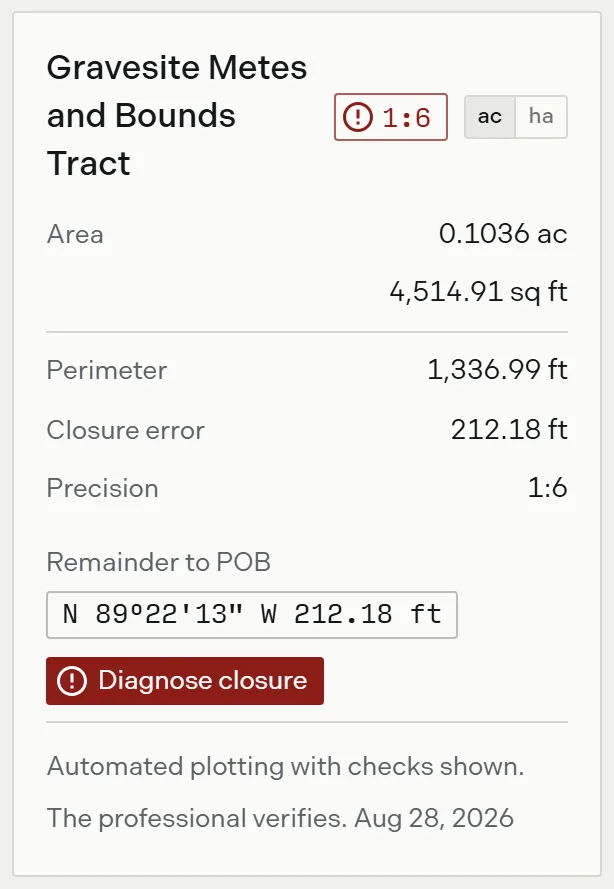
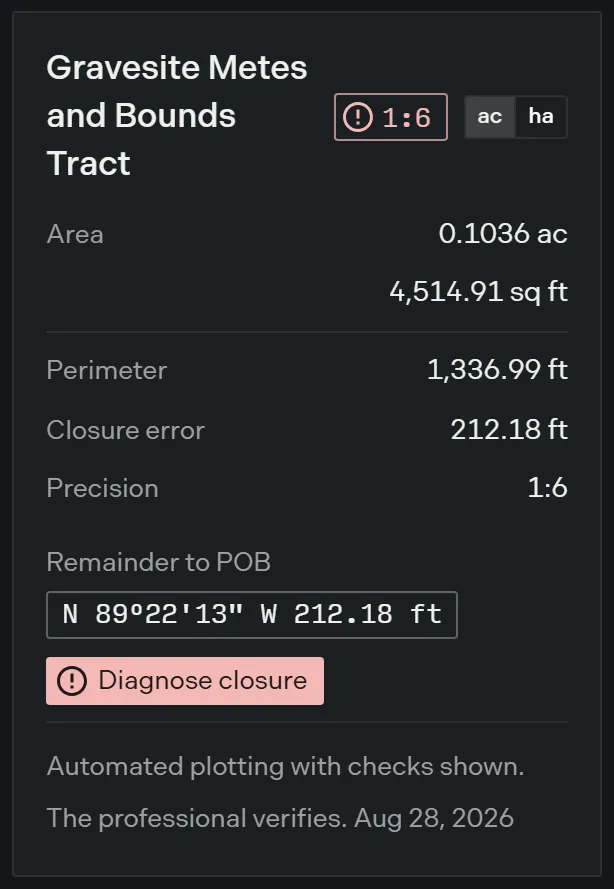
- Worse than 1 in 1,000. Trace offers Diagnose closure at this point, because a ratio this poor is almost always one wrong call rather than accumulated rounding. Diagnose a closure problem covers it.
The fastest read is not the ratio at all. Set the closure error against the perimeter. An error of 212.18 ft on a 1,336.99 ft perimeter is a whole missing or misread course.
The ratio only covers the calls Trace read
The ratio is worked out from the calls that made it into the traverse. A call Trace cannot read is marked with an error beside its line in the manual plotting editor and then left out, and the ratio is worked out as though that call had never been written. Nothing in the figure says a call is missing.
A dropped call usually wrecks the ratio, and that is the useful case: an error roughly the length of one course is the signature to look for. The dangerous case is the other one. Where the dropped call sits between two courses that double back, the traverse closes anyway, so there is no ratio to read at all and Trace reports Closed with nothing against it.
Read the error markers in the editor before you read the ratio, and count the calls you got against the calls the description gives you. When a call will not plot covers both.
What a good ratio does not tell you
- Whether the description matches the ground. A deed plot is the record boundary. Closure is internal consistency, measured on the words.
- Whether it is the right tract. A description can close to 1 in 100,000 and describe the neighboring parcel.
- Whether every call was read correctly. Errors can compensate. Two mistakes of opposite sign in the same traverse partly cancel, which is why a clean ratio is necessary and not sufficient.
- Anything about a centerline easement. A corridor does not close, so it carries no ratio at all. The corridor report is its equivalent.
Trace shows the ratio so the reviewing professional has something to check the description against, which is the whole job the number does.
One number, two calculations
Trace works the same traverse out twice, so the ratio can differ in the last digit between the manual plotting tract card and the closure report. Quote the one you read it from. How closure works sets the two side by side.
Related
- How closure works, for where the ratio comes from
- The closure report, for the rating and the arithmetic
- Verifications, for the other four checks
- Diagnose a closure problem, for a ratio worse than 1 in 1,000